| Product | Rating | Price |
|---|---|---|
 1. 7 Wonders Duel Asmodee Best Overall 2-Player Game 1. 7 Wonders Duel Asmodee Best Overall 2-Player Game | Check Price | |
 2. Patchwork Lookout Games Best Abstract Puzzle for Two 2. Patchwork Lookout Games Best Abstract Puzzle for Two | Check Price | |
| 3. Jaipur Asmodee Best Trading Card Duel Game | Check Price | |
 4. Codenames Duet (2nd Edition) Czech Games Edition Best Cooperative 2-Player Game 4. Codenames Duet (2nd Edition) Czech Games Edition Best Cooperative 2-Player Game | Check Price | |
 5. Azul Plan B Games Best Tile-Placement Game for Two 5. Azul Plan B Games Best Tile-Placement Game for Two | Check Price |
Detailed Reviews
Asmodee
1. 7 Wonders Duel
Pros
- Designed exclusively for two players — every mechanic assumes exactly one opponent, with no scaling or compromise
- Three winning paths (military advance, science supremacy, or civilian points) create genuinely different strategic tension each game
- Ages 10 and up, 30 minutes — a full competitive experience without a long time commitment
Cons
- The three-age card structure takes a session or two to fully internalize before strategic decisions feel confident
- No cooperative option — players who prefer working together will find Codenames Duet a better fit
7 Wonders Duel condenses civilization-building into a 30-minute two-player duel for ages 10 and up. You draft from a shared card layout, blocking what your opponent needs as much as building your own engine — a military breakthrough or a complete science set wins the game immediately, independent of points. Few two-player games sustain this level of strategic tension at this run time.
Lookout Games
2. Patchwork
Pros
- Designed exclusively for two, with a time-and-button economy fully calibrated for one-on-one play
- Physical Tetris-style patch tiles give the game a tactile quality that card-based two-player games lack
- Ages 8 and up in 30 minutes — accessible across a wide age range while retaining real strategic depth
Cons
- Abstract quilting theme will not appeal to players who prefer competitive narrative or direct confrontation
- Tile-fitting decisions can cause sessions to drag when one player deliberates every placement
Patchwork is a two-player abstract game for ages 8 and up where both players take turns acquiring Tetris-style patches from a circular market, spending time tokens and fitting tiles onto personal game boards. Filling your quilt efficiently while spending the fewest buttons is harder than it looks — the shared market creates indirect blocking without ever feeling arbitrary.
Asmodee
3. Jaipur
Pros
- Strict two-player design built around a shared market — every rule is optimized for the head-to-head format
- Teaches in a single read-through and can be played immediately, with no prior hobby game experience required
- Camel herd mechanic adds a resource-management layer that distinguishes it from straightforward hand-management games
Cons
- Market card randomness occasionally produces lopsided opening draws, though this typically evens out in a best-of-three series
- Strictly two players with no option to add a third — a different game is needed when group size grows
Jaipur is a two-player trading duel for ages 10 and up set in a Rajasthani market, where players acquire and sell goods — silk, spices, gold, diamonds — racing to outscore each other across two winning rounds. Sessions run roughly 30 minutes. It teaches quickly enough to play within minutes of opening the box, making it one of the most practical introductions to dedicated two-player gaming.
Czech Games Edition
4. Codenames Duet (2nd Edition)
Pros
- Fully cooperative — both players simultaneously act as spymasters giving clues and guessing, with no winner or loser
- Can expand beyond two players when a small group joins, unlike the strictly two-player games on this list
- 2nd Edition refines the timing track and mission structure, improving flow over the original
Cons
- Cooperative format means competitive players looking for a head-to-head winner will prefer the other four games here
- Clue-giving quality depends on shared vocabulary and cultural overlap — a wider gap between players can make it harder than expected
Codenames Duet is the cooperative two-player take on the Codenames word game, where both players act as spymasters at the same time. Each player knows which agents the other must identify but not the assassins the other must avoid — so every clue carries risk your partner cannot fully see. The 2nd Edition refines the timing track and difficulty settings, with a tunable turn limit that lets you make each session easier or harder.
Plan B Games
5. Azul
Pros
- Spiel des Jahres 2018 winner — one of the most recognized design awards in hobby board gaming
- At 30-45 minutes with 2-4 players, it fits a two-player evening without demanding a long session
- Tile-denial becomes more direct at two players, adding competitive sharpness that spreads more evenly across larger groups
Cons
- Supports 2-4 players, so it is not a purpose-built two-player game — dedicated designs like Patchwork give the two-player format more focused mechanics
- Players who analyze every possible draft choice before moving can slow the game's pace noticeably
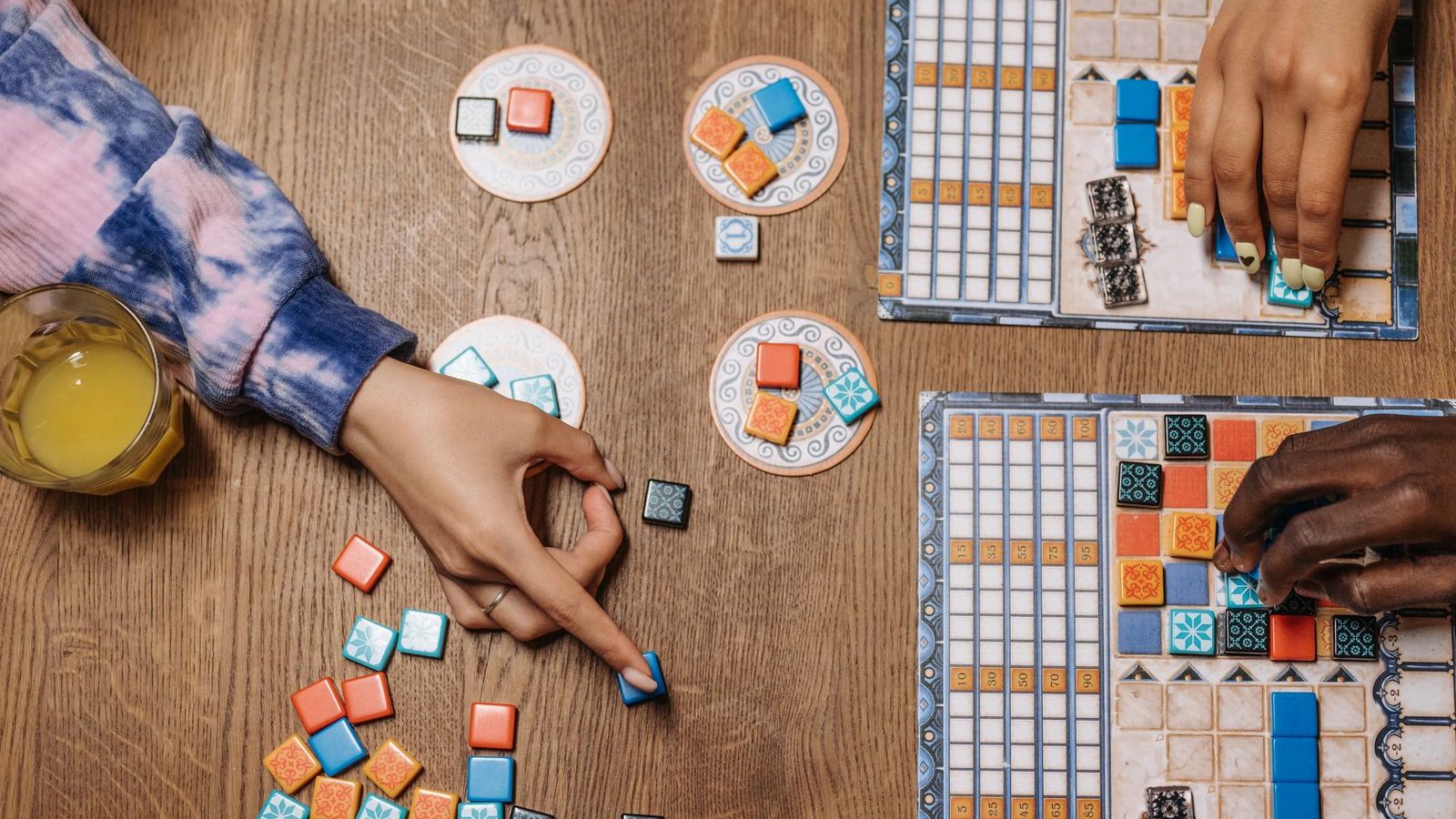
Azul is the 2018 Spiel des Jahres winner and one of the most-replayed abstract games of the last decade. Players draft colored tiles from central factories to complete mosaic wall patterns, and leftover tiles go to a penalty row — every pick is simultaneously constructive and potentially disruptive to an opponent. It scales from 2-4 players and plays well at two despite not being exclusively designed for the format.
How We Picked
We focused exclusively on games that either play only two players or are genuinely well-suited to the two-player format as confirmed by publisher design intent and owner reviews. For games that support two but also scale to three or four — like Azul — we checked whether the two-player experience holds up: does downtime increase, do key mechanics weaken, or does the game feel like a reduced version of a larger design? We cross-referenced BoardGameGeek community ratings, publisher specifications for age and play time, and owner reviews filtered to two-player sessions. Award recognition provided supporting context: Azul won the Spiel des Jahres in 2018, and 7 Wonders Duel has held consistently strong community standing since its release. Play time accuracy matters especially for two-player gaming, where sessions are often confined to a weeknight, so we compared publisher play-time figures against reported actual session lengths. No games were played by our team.
Buying Guide
Designed for Two vs. Scaled Down
A game built exclusively for two plays differently from one that supports two but was designed for more people. 7 Wonders Duel, Patchwork, and Jaipur were created with no other player count in mind — every rule, balance decision, and timing element assumes exactly one opponent. Codenames Duet was designed with two in mind but expands gracefully. Azul supports 2-4 players and holds up at two, though the factory-drafting dynamic shifts with fewer players pulling from the same factories. If you primarily game with one other person, a purpose-built two-player game is generally the more focused investment.
Play Time
All five games run between 30 and 45 minutes, making them among the most practical options for two-player gaming on weeknights. 7 Wonders Duel, Patchwork, and Jaipur each average around 30 minutes, leaving room for a second game or a natural best-of-three series. Azul runs 30-45 minutes depending on how deliberately players consider each turn. Codenames Duet finishes faster on beginner missions and stretches on the harder campaign levels. None of the games here carry the 60-90 minute commitment that makes some strategy games difficult to fit into an ordinary evening.
Strategy vs. Luck
The five games here cover different points on the strategy-to-luck spectrum. 7 Wonders Duel and Patchwork lean heavily strategic — the initial card or tile arrangement varies, but skilled players win consistently over a series. Jaipur has meaningful card randomness in the shared market, though a best-of-three format reduces luck’s effect on the final outcome. Azul is primarily strategic with variable factory configurations each round. Codenames Duet is vocabulary-and-association-driven: the main variable is whether the clue-giver and guesser share the same mental connections, which is a different kind of challenge than traditional randomness.
Cooperative vs. Competitive
Four of the five games here are competitive head-to-head. Codenames Duet is the single cooperative option, where both players win or lose together. The competitive games differ in how directly they target each other: Jaipur is pure market racing, 7 Wonders Duel has direct military and science confrontations that can end the game suddenly, Azul involves tile-denial plays, and Patchwork is the most indirect — blocking your opponent means taking a patch they want from the shared market rather than confronting them directly. Choosing based on how much direct player conflict you enjoy is one of the most reliable ways to narrow this list.
Age Range and Accessibility
7 Wonders Duel and Jaipur recommend ages 10 and up, reflecting the abstract victory conditions and hand-management decisions involved. Patchwork is accessible from ages 8 and up, and the tile-fitting goal is intuitive enough that new players grasp it within the first few turns. The publisher recommends Azul from ages 8 and up; the game’s rules are straightforward enough to teach in under 10 minutes despite the strategic depth underneath. Codenames Duet’s suitability depends more on vocabulary and shared context than on a specific age; it works well for adults and older teens comfortable with word association under time pressure.
Starting a Two-Player Game Collection
If all five games here are new to you, a practical acquisition order is: Jaipur first — fastest to explain and the most immediately playable — then Patchwork for spatial variety, then Azul to add tile-drafting with broader group flexibility, then 7 Wonders Duel when you want the highest strategic ceiling on this list. Codenames Duet fits best as a cooperative counterpoint once the competitive options are familiar.
Most games here stay in regular rotation for years. Jaipur, Patchwork, and Azul in particular generate the kind of replayability that justifies permanent shelf space. For households that also play games with kids or in larger groups, several of these games pair well with options in our best board games for families guide, where age ranges and complexity levels overlap for mixed sessions.